
Do Bees See in Color?
As humans, imagine strolling through a vibrant garden. Flowers burst in reds, pinks, blues and yellows that catch our eyes right away. But how do bees see such a colorful floral world? Well, we’ve had a few customers lately ask us whether bees can actually see in color, and that is a very good question. As experienced beekeepers, in addition to bee control professionals, we can definitely answer that question.
First let’s consider some facts about bees that can lead us to the correct conclusion.
Bee Eye Anatomy
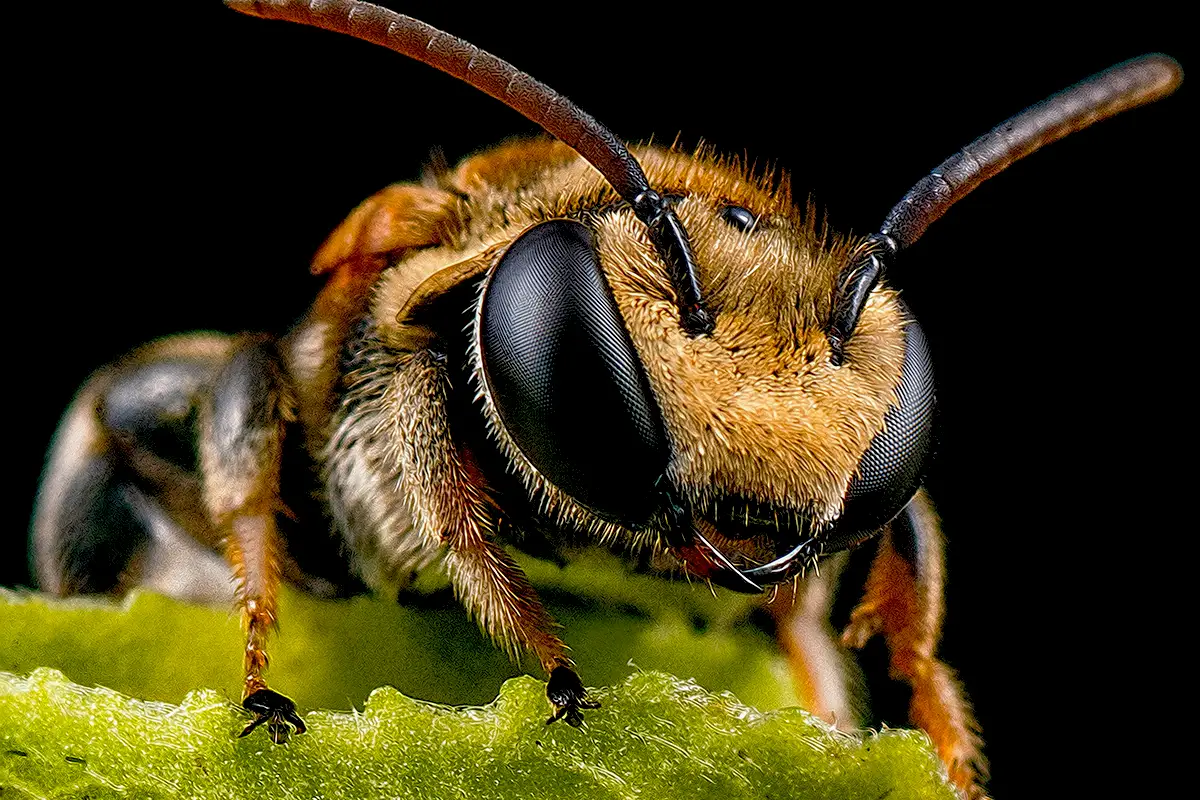
Bees have two big compound eyes on the sides of their heads. Each eye holds thousands of tiny “lenses” called ommatidia. These work like a mosaic, snapping together a wide-angle view of the world. Unlike our single-lens eyes, this setup lets bees spot movement from all directions.
Now, on top of a bee’s head and between their compound eyes, sits three small ocelli. These simple eyes don’t form images. They mainly sense light levels and help with flight balance. Think of them as built-in stabilizers during quick turns in the air. Bees use this combo to stay oriented even on cloudy days.
While human eyes rely on three cone types for red, green, and blue hues, bees eyes are set up differently. Their eyes have photoreceptors tuned to ultraviolet, blue, and green light. Each ommatidium contains cells called R1 to R9, with specific jobs in color detection.
These receptors form a trichromatic system, but they lack a strong red sensor, so their color map emphasizes shorter wavelengths. This difference shapes how bees pick out safe paths and sweet spots in flowers.
How Fast Do Bees See?
Bees see motion in a blur where we might miss it. Their flicker fusion frequency hits about 200 Hz. That’s triple what humans manage at around 60 Hz. In short, bees are able to catch rapid changes, like wing flaps or dodging obstacles. During flight, this speed helps. A bee zips at 15 miles per hour and still tracks flower details. This quick vision helps them with foraging too.
The Ultraviolet (UV) Vision of Bees
Humans stop at violet in the color spectrum. Bees’ vision extends further into ultraviolet rays. That said, bees don’t “see” UV as a separate color. It mixes with others to form unique shades.
Flower Patterns
Many flowers hide bullseyes in UV. Take sunflowers, they look plain yellow to us. In UV, dark streaks point to the center like runway lights for bees. And daisies do the same. Their petals reflect UV at the base, forming a target. This “nectar guide” cuts search time. In this way, bees can work more efficiently as they land precisely and sip faster.
Color Constancy and Adaptation
As natural light shifts from dawn to dusk, bees keep colors steady anyway via a trait called color constancy. Their brains adjust signals to match true flower tones, rain or shine. This helps in varied weather. A blue bloom stays blue under gray skies. Without it, bees might mix up targets and waste energy.
How Bees Perceive Human Colors
Ever wonder why red flowers flop with bees? Their color wheel spins differently. Blue and violet stand out sharp for bees. Their blue receptor peaks early, making these hues vivid contrasts. It draws them to lavender fields or hyacinths. Thus, blues, yellows, purples and violets are preferable to bees.
Using Bee Vision for Gardening and Agriculture
Bee sight isn’t just cool science. It shapes real choices in yards and fields. You can use it to draw more pollinators and grow better.
Choosing Pollinator-Friendly Plants
Plant blues and purples to lure bees. Lavender, salvia, and bee balm shine in their view. Skip reds and opt more towards violet. Yellows work well too.